
Sport Leadership Spotlight: Peter Feigin
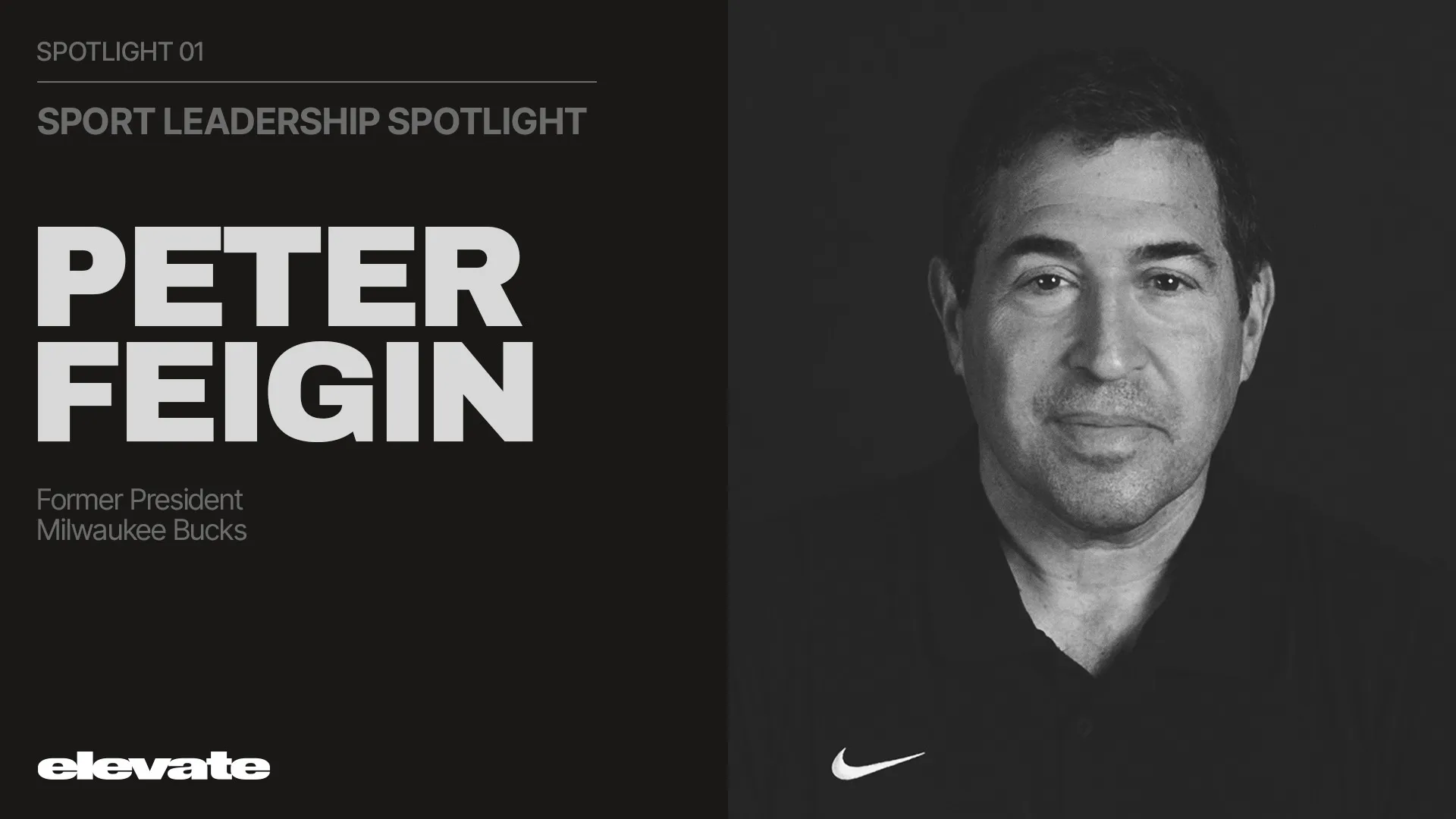
Peter Feigin on creating followership, intentionally hiring outside of sports, and why that unconventional instinct is critical for the future of pro sports.
After more than a decade leading the Milwaukee Bucks through a championship, a new arena, and the creation of the Deer District, Feigin explains why modern leadership is not about reacting in the moment. It is about aligning people before decisions are ever made. That mindset reflects something deeper. Not just how he leads, but how he builds organizations.
Peter Feigin did not become a key figure in the Milwaukee sports world the conventional way. He was never the lifelong sports executive grinding his way up from intern to team president. His career began at Six Flags, where he learned how to drive ticket sales. From there, he moved to Madison Square Garden, running partnerships before rising to Chief Marketing Officer. Then came a hard left turn into private aviation, followed by a stint in post-production media, where he had a front-row seat to an industry getting disrupted in real time.
The path to the Bucks came through Peter's identical twin brother, Dan Feigin, who ran a private school in New York where one of the future Bucks owners sent his children. During a parent-teacher conference, one of the children mentioned their father's interest in purchasing a team. Dan suggested that they speak to Peter instead of relying on hedge fund analysts to vet potential deals. A few dozen trips to evaluate franchises later, Feigin ended up in a room with Senator Herb Kohl, the then-owner of the Milwaukee Bucks, and called Marc Lasry hours after that meeting to say: If you want this team, I think I know how to make it happen without going to auction. Lasry and Wes Edens purchased the franchise in 2014, and Feigin worked closely with both owners throughout his tenure.
What followed was one of the more remarkable runs in recent NBA history. A championship in 2021. A new arena. The creation of the Deer District, a mixed-use development that transformed a franchise into a year-round community platform blending real estate, hospitality, entertainment, and urban planning.
And now, as Feigin transitions out of the president role, he sat down with us to talk about what he built, how he built it, and what he thinks comes next for the industry.
Your career path is anything but a straight line into sports. How do you think those stops shaped the way you lead?
Every one of those experiences contributed something different. Six Flags taught me the basics of how to drive people through a door and sell tickets. Madison Square Garden was an incredible honing experience, though I'll be honest, it's almost impossible to fail there. The market is so embedded, the pipeline of sponsors and ticket buyers is so strong, that you could be great, mediocre, or terrible and still look okay. NetJets was where things got really broad. I was managing labor, treasury, debt, global operations. It was a completely different scale of problem-solving than anything I had done in sports or entertainment. And at every stop, I was just over curious. I wanted to know how everything worked, what everyone's job felt like, how things were actually made. My only real skill is collecting people. I genuinely don't think there's a problem I couldn't eventually solve by pulling together the right group of people from across my network. That's what all those years outside of sports gave me.
When you got to Milwaukee, what did building a leadership team look like?
I always thought about executive leadership as additive. Not duplicative. What are we missing? What kind of thinking are we not doing yet? And I think that's even more urgent now than it was when I started.
If you are not hiring developers, experienced operators, designers, data specialists, people who approach problems in ways that the traditional sports executive pipeline does not produce, then you are falling behind. The future of these organizations is not going to be built by people who have only ever worked in sports. I am living proof of that, and I tried to hire that way the whole time I was there.
How much of your time as president was actually spent on people and org structure versus everything else?
A lot. More than most people would expect. And I think if you are a leader and you are not spending a significant portion of your time on people, on vision, on figuring out who your stars are and being honest about who is not performing, I genuinely don't know what you are doing. We got very good at managing out the toxic non-performers. That is not easy, but it matters enormously for the health of an organization. And beyond that, you are always thinking about what the org structure needs to look like as the business evolves, especially now when so much is changing around data, automation, and platform integration.
How has the commercial operation changed since you started?
It is surreal when I think about it. Twelve years ago, you were doing billboard deals and static ads. Now your entire marketing plan is responsive. Short-form video and social media do the work that outdoor used to do. Think of what Salesforce has done. CRM is the spine of our entire business. The data and personalization capabilities that exist now would have seemed like science fiction when I walked in the door. What I find most interesting is the question we are all trying to answer every single day: what is the human role, and what is the automation role? Because you have to get that balance right.
Is there anything that automation cannot replace?
The hospitality. The human touch on the retention and service side. When you are in an experiential business, people want to be with people. They want to feel appreciated, rewarded, seen. That emotional connective tissue is not going away. And I think the teams that will win are the ones that use automation to create efficiency and scale and then point all of that freed-up human energy back toward the fan experience. We are selling emotion. We are selling passion.
You were one of the earlier team presidents to really build a mixed-use district, and you have been working with the San Antonio Spurs on their new arena and development initiatives. How do you think about what the Deer District became?
It is a complete mind shift. You go from 41 home games to a 365-day destination. That is not just a different business model. It is a different organization. It requires real estate people, urban planners, feasibility experts, programmers, operators. And here is something teams underestimate: the person who books your arena is not the same person who activates a public plaza. Your arena person is thinking about event nights. Your plaza person is thinking about yoga on Sunday mornings and Christmas markets. Those are completely different jobs with completely different networks. You need both, and you need to build the labor infrastructure to actually run it all before you start building. I gave the Spurs a list of 50 things to think about. I'm sure they thought I was insane. But it's every detail. The feel, the revenue, the cost per square foot, the design. The real estate development side has honestly been the most exciting learning experience of my career.
You spent twelve years working with a diverse ownership group. How did you manage that?
Communication, above everything. Over-communication, really. I had three general partners, and I would have failed immediately if I had tried to make decisions in isolation and bring them finished recommendations. What I learned to do was pre-socialize everything. Get directional buy-in early. Never surprise them. Never lose a vote. There were no major capital allocations or strategic decisions that came to a formal moment without me already having a strong sense of where they stood. That is true for ownership. It is also true for your executive team, your sales department, everyone. If you cannot communicate the rationale for where you are going clearly enough that people actually believe it is possible, they will not follow you there.
As you step back from this chapter, what are you most proud of?
The relationships. That is the only honest answer. The friendships. The people. I moved recently and went through a lot of stuff I had accumulated over the years, trophies and mementos and material things, and none of it moved me. What I keep coming back to is that I had a professional family for twelve years. People I trusted. People I laughed with. People I went to battle with. That is the thing I am most sad to leave behind as I move into whatever comes next. I have been lucky in ways I genuinely could not have imagined when I started out. But at the end of the day, all I really care about is people. That has been true the whole time.
By Meredith Damore, SVP, Organizational Effectiveness & Managing Director, Leadership Advisory Practice, and Brendan Donohue , Managing Partner of Elevate Talent and Special Advisor to the CEO, with contributions from Caro Carmichael
Subscribe on LinkedIn here.