





Sport Leadership Spotlight: Haley Carter
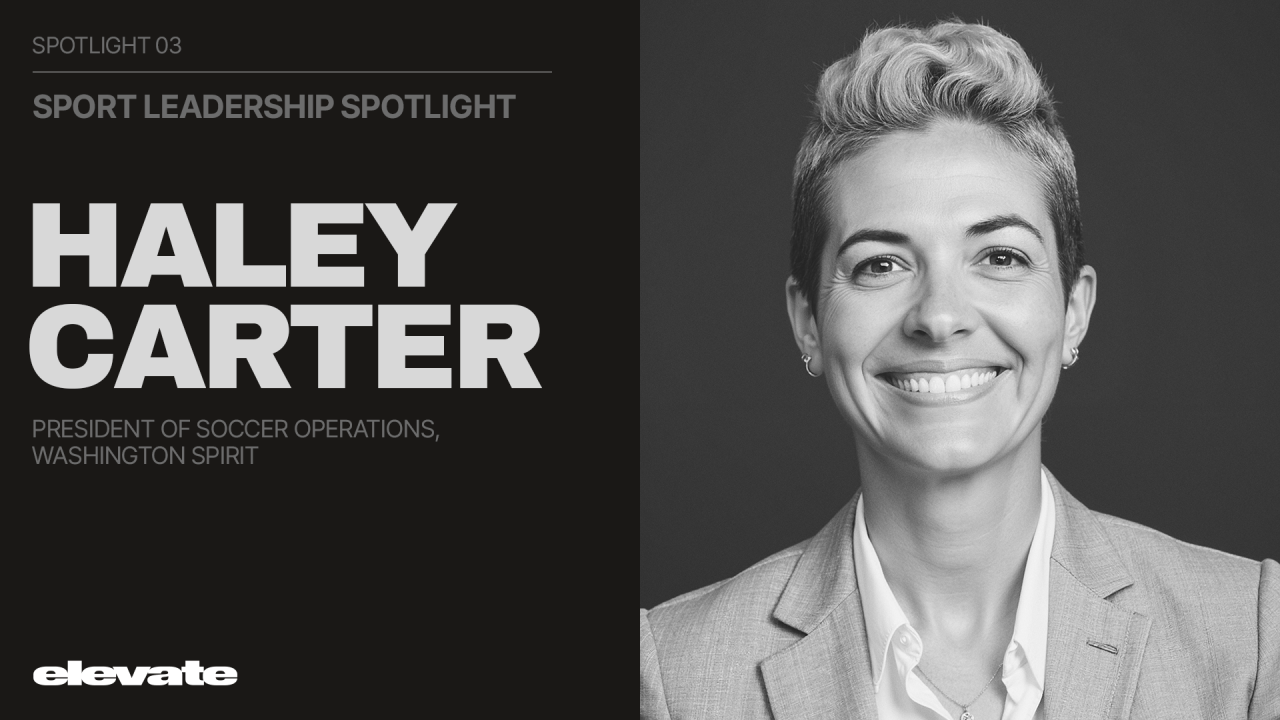
Certainty Is Expensive to Fake: What Haley Carter Learned About Leading When Nothing Else Was Left
In August 2021, Haley Carter, JD/MBA had no rank, no title anyone recognized, no budget, and no leverage over a single government, airline, or embassy. What she had was a group of players on the Afghan national women's soccer team hiding in safe houses in Kabul, and a plan she could not promise would work.
"All that we had left was whether people believed what we told them," she said. "Stripped of everything else, leadership is the credibility in conditions where you cannot compel someone to do something, and you cannot guarantee anything."
Carter, now President of Soccer Operations for the Washington Spirit, has continued to treat trust as vital to her leadership strategy. Every conversation with a player, coach, or owner is a version of the same question: did the people she is responsible for believe her when believing her cost them something?
Carter has spent her whole career choosing the harder option. At every turn, she has put herself in situations with no guaranteed outcome and no one else to answer for the result. Carter was a Division I goalkeeper at the Naval Academy who did not start until her senior year. She commissioned into the Marine Corps and spent close to eight years as a logistics officer, playing for the All-Armed Forces team between deployments. She also earned an MBA while still in the Marine Corps, then played three seasons for the Houston Dash while working a full-time corporate procurement job. She coached the Afghan national women's team and went to law school at night. She ran soccer operations for the Orlando Pride, won the NWSL championship there, and then left for Washington, where she walked into the Trinity Rodman contract negotiation on roughly day five. Here is what all of that taught her.
She Had to Unlearn Competence as Performance
Carter came up in a system that rewards certainty. In the Navy and the Marines, she believed her job was to be the most competent person in the room and show zero vulnerability while doing it. She would absorb all the doubt herself so the people under her never had to see it. She has thrown that out, saying,
"Certainty is a very expensive thing to fake.”
What people actually need, she has come to believe, is clarity. Share what you know. Share what you don’t know. Set expectations for when you can share more. While it may sound simple, it is much harder than projecting confidence, because it requires saying "I don't know yet" out loud to people who are anxious, in environments where the pressure is real. Carter quickly points out that admitting you don't know is not the same as not deciding. You still decide. You are just honest about the conditions you are deciding in.
Competence still matters a great deal to Carter. She admits she ostensibly spite-attended law school partly because a company lawyer once explained indemnification to her as if she had never heard the word. But she stopped confusing being capable with looking like she had it all figured out.
Rank Gets You Compliance Only
Carter let go of the idea that loyalty flows upward because of a title.
"Rank will get you compliance," she said. "Your title will get you compliance. But credibility really gets you everything else."
She learned this leading Marines and says it holds just as true in a locker room or a front office, and insists credibility isn't something you earn once. It gets rebuilt in every small interaction, every day, and it can be spent down just as fast.
Trust When There is No Track Record
When Carter arrived in Washington, the Trinity Rodman contract negotiation was already public. She was making consequential decisions with people who had no history with her [aside from negotiating against her], and she had none with them.
"Every call we were making was basically doing two jobs at once," she said. "Solving the problem of getting Trinity's contract done, and building the evidence that people were going to use to decide whether or not I was any good at my job."
She admits it is an uncomfortable way to spend your first few months anywhere. Public negotiations also bring what she describes as a lot of confident opinions from people who carry none of the consequences. There was criticism of the league's high-impact player rule, and some of it continues today. Her view is that the rule was the rule, and her job was to work within it and get the deal done.
What that requires, in her words, is being willing to look wrong in the short term to be right in the long term. You have to be comfortable being misunderstood. You have to be at peace with not correcting the record, because most of what happens inside a negotiation like that will never be known outside it.
Her advice for anyone walking into a similar situation is a little counterintuitive. Do not try to earn trust through outcomes. Outcomes take time, and you will not always get the one you want. Earn it by being predictable about process. Tell people how you will make decisions before you make them, then decide that way every time, even when it costs you.
“I think you learn a lot about people in one hard month than in six comfortable ones,” she said when discussing the impact of high-pressure environments.
Trust is built through consistent behavior over time. You show up the same way you showed up yesterday. Who tells you the truth when the truth is unwelcome. Who brings solutions instead of problems. That negotiation compressed years of trust-building into a few weeks, and she now knows exactly who she is working with.
Why Leave After You Win
Carter had a championship in Orlando. She could have stayed. Why didn't she?
"If I'd stayed, I would have just been spending credit I'd already earned," she said. "There's a version of this career where you win once, and then you rent that win for a decade, and everybody lets you because the result is right there on the record."
Orlando was an underdog when she arrived, giving her a floor. Nobody expected much, so progress read as progress. When she arrived at Washington, it was a different story entirely, as the Spirit have been top contenders for years. With this transition, she inherited expectation instead of hope, and expectation is harder to manage than a rebuild. She could have stayed in Orlando and coasted on a title. Instead, true to form, she chose the challenge.
A through line runs through every move she has made. Leaving the Academy, leaving the Marine Corps, going to Afghanistan, coming into the NWSL. Each time she walked into a room where none of what she had done before counted for anything.
"I'd rather have to be right again than just be relied on for my history," she said.
Leaving the Path Wider
Carter’s personal values are service and reliability, and she traces both to a childhood where she never wanted for anything because her parents worked for it. She often cites Roosevelt's "Citizenship in a Republic," the speech most people know for the man in the arena, but the line she holds onto is different: to whom much has been given, much is expected.
She is candid about the arithmetic of her own path. A degree with honors from the Naval Academy, an MBA with distinction, a law degree, legal practice, international coaching, a professional playing career.
That is what it took for her to be considered qualified for a job that other people hold with half of these accolades. She doesn't say this with bitterness, but as a measure of where the industry still is. So when people ask what "leaving the path wider" actually means, she has concrete answers that apply well beyond soccer.
First, count the right thing. Not how many women are in the building, but how many are in rooms where decisions get made, with budget authority and the ability to say no. Getting women in the door is easy, she said. Giving them material decision rights is the real measure. In women's soccer specifically, the technical pipeline is the bottleneck.
Second, make the changes structural, so they outlive you. Written pay bands.
Maternity and nursing accommodations that are policy, not favors negotiated case by case. Medical staffing standards. Facilities designed around the women who use them.
Third, and she thinks this one is underrated, make the jobs survivable. The problem is often not getting women into the industry. It is keeping them, whether as athletes, coaches, or executives. People leave in year six because the job costs more than it gives back. Several players and staff members are moms, and their kids are often in the building.
Carter's position on it is blunt: having kids around is not going to make anyone do their job differently. What it does is let people show up as whole people.
When asked how she manages a superstar in the locker room, her answer came back to the same theme. Trinity Rodman knows exactly what her contract means for the women's game, and she has chosen to carry that weight confidently, as a standard-bearer. Her teammates see it. Carter’s on-pitch leadership group has seven players, and each leads a little differently. She would love to take credit as a staff, she said, but it is their locker room.
Forty-five minutes with Carter barely scratches the surface. But if there is one thing to take from the conversation for anyone leading anything, it is the question she asks herself after the rank and the title and the resume are set aside. Did the people I'm responsible for believe me when believing me cost them something? If you can answer yes, you probably have the kind of credibility that survives a bad month. If you can't, she would tell you that is where the work starts.
Haley Carter is very excited for her favorite tournament, the Women’s World Cup, in Brazil next year and plans on attending some games.
By Meredith Damore, SVP, Organizational Effectiveness & Managing Director, Leadership Advisory Practice with contributions from Caro Carmichael
Subscribe on LinkedIn here.